Mining Tycoon Loads Up on SpaceX Stock

Originally published by Rhiannon Hoyle of The Wall Street Journal
15.06.2026
Gina Rinehart, Australia’s richest person, has bought a more-than $1 billion stake in SpaceX SPCX 4.83%increase; up pointing triangle, betting on founder Elon Musk and what she says is the potential for his rocket maker to shape industries for decades.
The stake in SpaceX, which last week pulled off the largest initial public offering ever, is the single largest investment outside of iron ore made by her closely held company, Hancock Prospecting, one of the world’s major exporters of the steelmaking commodity.
The investment reflects Hancock’s confidence in Musk and recognizes the need for the West to keep investing in technology and innovation, Rinehart said in emailed remarks on Monday.
“We see SpaceX as a rare business: led by a truly exceptional person, technically exceptional and operating in sectors that are crucial, and with long-term potential,” she said. Rinehart didn’t specify the value of the investment but a person familiar with the investment said it was valued in excess of $1 billion.
Last week’s historic IPO, powered by an army of individual investors, turned SpaceX into one of the U.S.’s most-valuable listed companies and Musk, who founded SpaceX in 2002, into the world’s first trillionaire. The company ended its first day of trading Friday with a market value of $2.1 trillion.
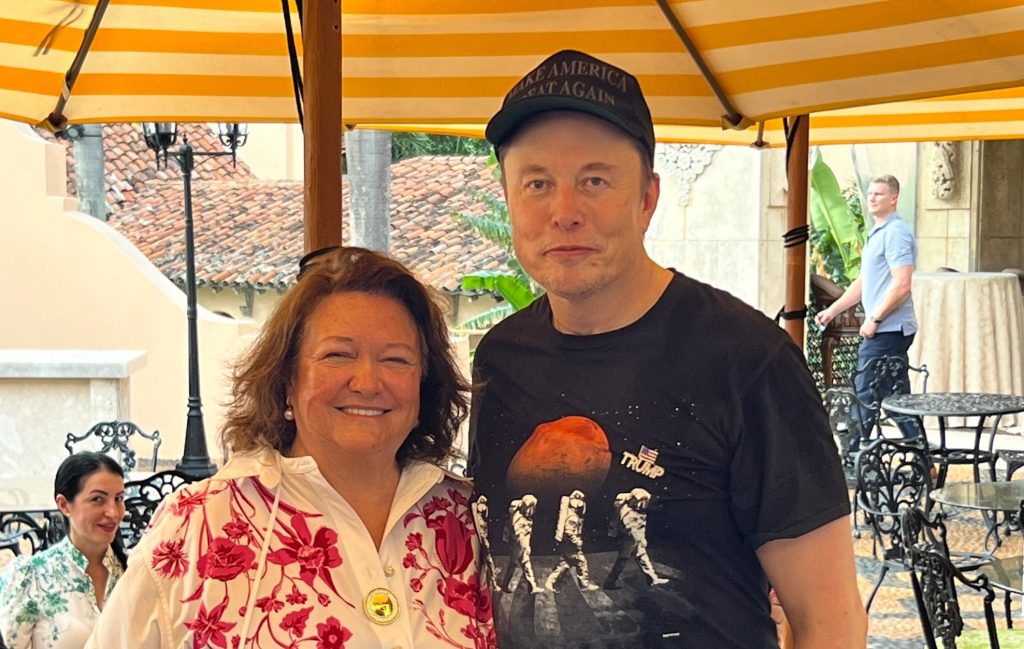
Despite building their fortunes on opposite sides of the world, Rinehart and Musk share an interest in conservative politics and issues. Rinehart was a guest at President Trump’s Mar-a-Lago resort on the night of the presidential election in November 2024. The next day she got a coveted sit-down with Musk where they discussed issues pertinent to the U.S. and Australia: free speech and the need to cut both government waste and national debts.
Rinehart—or Mrs R., as many of those closest to her say—emerged as a supporter of Trump during his first run at the White House, toasting his ambition to cut taxes and reduce what he sees as overregulation. Those are polices she has long campaigned for Down Under.
Rinehart said that “SpaceX stands apart as the only company globally building integrated hardware and software across its core segments of space, connectivity and AI,” or artificial intelligence. “Its work will continue to shape industries, economies and opportunities for decades to come,” she said.
SpaceX has already sparked a nascent space economy, and Musk has a long-term vision of a multiplanetary future that includes AI data centers in orbit and colonizing Mars.
Rinehart, the world’s 104th richest person with a fortune around $25.2 billion, according to Forbes real-time rankings on Sunday, has met with Musk several times, said Hancock Chief Executive Garry Korte.
Her closely held company built a giant iron ore mine in Australia’s Pilbara, where Rinehart’s father, Lang Hancock, is widely credited with discovering a bounty of iron ore in the 1950s. Today, roughly half the world’s iron-ore exports come from that region.
Hancock has since made investments in a number of industries, including in technology and media. It has also bought stakes in critical minerals companies, particularly those involved in rare earths, widely viewed as essential to modern technologies.
Korte said the Australian company was interested in “working with” SpaceX in the future.
“We…see the possibility of mutually beneficial arrangements between SpaceX and Hancock Prospecting’s significant critical minerals investments, as demand grows for the materials and infrastructure needed to support advanced technology,” Korte said, without elaborating.
A spokesman for Hancock said the company has no further plans to invest in space outside of SpaceX.
