From advisor to target: Anthony Albanese faces Sir Keir Starmer’s populist fight

Originally published by Geoff Chambers of The Australian
12.06.2026
By the end of September last year – only 14 months after British Labour’s landslide election victory – Starmer had driven his party’s primary vote into the high teens after losing control of his government’s political management of immigration, crime and social cohesion.
Albanese and Carney, the Canadian Prime Minister who had hosted the Australian and British prime ministers at the Kananaskis G7 summit, were revelling in the glow of election victories when they travelled to the Old Dart to huddle with a flustered Starmer at 10 Downing Street.
Carney, the first non-British citizen to hold the post of Bank of England governor, had pulled off one of the great political turnarounds in April last year after replacing the hapless Justin Trudeau and winning an unlikely fourth term for the centre-left Liberal Party of Canada.
Albanese – who by the end of 2024 had fallen behind Peter Dutton’s opposition in the polls and boasted a minus-21 net approval rating in February 2025 – delivered his own Lazarus-like performance by winning 94 seats and a second term at the May 3 election.
After announcing a clumsy mandatory digital ID system targeting illegal migrants, Starmer greeted Albanese and Carney at Central Hall Westminster before their joint appearance at the Global Progress Action Summit, a gathering of progressives featuring left-wing identities including Spanish Prime Minister Pedro Sanchez, former New Zealand prime minister Jacinda Ardern and senior US Democrats JB Pritzker, the Governor of Illinois, and Pete Buttigieg, who had been transportation secretary in Joe Biden’s government.
Albanese’s presence in Britain, which was secured after Starmer offered his Australian counterpart a keynote address at the Labour conference in Liverpool, was orchestrated to provide strategic advice to the British Prime Minister and his cabinet.
Starmer and colleagues wanted to pick Albanese’s brain on how he turned the tables on the Coalition at the election and how his Labor government was keeping out illegal immigrants.
Albanese, fresh from recognising Palestine at the UN and taking a selfie with Donald Trump in New York, arrived at Downing Street with Jodie Haydon on a Friday night grasping a four-pack of Willie the Boatman Albo beers to share with Starmer and Carney.
The early evening catch-up was the casual talks rather than the formal strategic discussion pencilled in for the Liverpool conference, where Albanese spoke privately with Starmer and his cabinet on issues including immigration and AUKUS.
Amid talk of Starmer’s leadership being under pressure, Albanese – a prominent member of the Rudd and Gillard governments bogged down by leadership warring – warned against rash moves against Starmer so soon after an emphatic election victory. Albanese believed Britain’s five-year terms afforded plenty of time for political recovery.
But the expected return to parliament of Greater Manchester mayor Andy Burnham in the Makerfield by-election next week is likely to precipitate the end of Starmer’s reign.
The shock resignation of British defence secretary John Healey during a visit to the UK by Defence Minister Richard Marles this week is being viewed as a precursor to Starmer’s final demise. Healey, whom Albanese hosted at Kirribilli House last year, has been one of the strongest supporters of the AUKUS pact and helped his Australian counterparts secure endorsement from Trump on the nuclear submarine pact.
Albanese is understood to have spoken plainly with Starmer and British colleagues about the tough decisions made by Australian Labor in endorsing Operation Sovereign Borders, boat turnbacks and strict immigration controls.
Introducing Albanese to the British Labour faithful, Starmer hailed him as an “inspiration to the left” and a key partner against the “divisive politics of the right”.
While Starmer struggled to keep his head above water in response to the rise of Farage’s Reform UK movement, Albanese was not worried about Pauline Hanson posing a similar threat.
Asked by this author during a press conference in London on September 26 last year if he was worried about a Farage-like rise of grievance politics in Australia that could drag down major party primary votes, Albanese said he didn’t “want to see the rise of populist organisations”. The Prime Minister said Labor’s May 3 election victory was a rejection of grievance politics and he declared the Coalition had “paid a price” for not putting up alternative policy work or constructive ideas.
The October Newspoll, published days after Albanese returned to Australia, showed Labor’s primary vote reaching 37 per cent, the ALP’s highest point since June 2023. The Coalition had risen a point to 28 per cent. One Nation, which secured 6.4 per cent of the primary vote at the election, rose to an eight-year high of 11 per cent.
The paradigm has been turned on its head in eight months. The June Newspoll published this week revealed a watershed moment in Australian politics, with One Nation (31 per cent) ahead of both Labor (30 per cent) and the Coalition (18 per cent) on primary vote support. The political earthquake Albanese didn’t believe was possible in Australia had arrived on our shores.
Chameleons
The Albanese government was left reeling after a summer from hell for Australians, headlined by the Bondi Beach massacre in which Islamic extremists shot, murdered and injured innocent Jewish Australians and bystanders.
Since Labor’s return to power in 2022, the cost-of-living crisis has become worse. Inflation and rates have kept rising. Heavy industries are closing. Housing supply is failing to keep up with demand. And the world is a more dangerous place, fuelled by tensions between superpowers, global conflicts, trade wars, the spread of misinformation via social media algorithms and the unfettered rise of artificial intelligence.
The big-taxing and deeply unpopular federal budget handed down by Jim Chalmers on May 12 sought to respond to all of these problems and surging support for One Nation, which had performed well at the South Australian election and won its first lower house seat in the federal parliament.
Inquirer understands that Albanese believes taking risks is more important than ever, even if it means Labor’s primary vote falls further behind One Nation and his personal performance ratings plunge below a record low of minus-24. Analysis of Newspoll archives shows the last prime minister who attracted 60 per cent or more dissatisfaction with their performance was Tony Abbott before he was rolled in 2015.
The Prime Minister remains relaxed about his government’s fifth budget and its contentious tax changes on negative gearing, capital gains tax and trusts. There will be some carve-outs in coming months but the Albanese government is determined to hold the line.
Labor ministers are saying, at this stage, the backlash isn’t as bad as campaigns waged against the Rudd-Gillard governments over the mining tax, carbon tax and mandatory poker machine reforms. Albanese’s cabinet is more concerned about forging a long-term plan ahead of the 2028 election to fight One Nation rather than sweating over the budget.
That strategy is underpinned by a Left-faction dominant Albanese government that is leaning harder into right-wing issues.
To avoid the Starmer path, Albanese is fixated with border security and keeping illegal arrivals out of the country. The NZYQ crisis and public fear about violent illegal migrants crystallised that thinking. The Bondi terror attack ensured border protection and national security returned as top-tier government priorities.
To win the 2022 election and claim power, Albanese and senior Labor figures believed they had to junk opposition to most Coalition-era border protection measures.
Ironically, the Prime Minister and his Left-faction allies now embrace the need to send illegal arrivals to Nauru and ship them out of the region as soon as possible.
It is thought some unaccounted arrivals who landed in remote parts of the country may have been eaten by crocodiles or sharks, illustrating the dangers of boarding rickety vessels used by people smugglers.
Across the board, the Albanese government is taking actions that don’t necessarily align with established Left-faction ideology.
The government is cutting the bloated National Disability Insurance Scheme, grandfathering beneficial tax arrangements for older Australians, avoiding means testing for subsidy programs, streamlining environmental approvals, bailing out heavy-emitting industries to protect jobs and going all-in with the US and Britain on AUKUS nuclear-powered submarines. That work is being led by Albanese’s left-wing allies, including Mark Butler, Katy Gallagher, Tim Ayres, Pat Conroy and Murray Watt.
There is a running joke in parliament that Labor’s Left faction appears more right-wing than the once proud NSW Labor Right faction, previously led by Paul Keating and Graham Richardson.
Some quip Albanese is the notional head of the NSW Labor Right, which boasts Tony Burke, Chris Bowen and Jason Clare as members.
On the rise of One Nation, Albanese and his advisers are grappling with understanding what is driving up to 70 per cent of Australians to want to tear down the major parties and blow up the show. The immediate strategy for the Labor government is to be seen as “agents of change rather than just agents of stability”, which is a different approach from where governments traditionally want to be. There is zero appetite to replicate Starmer’s tactics and lurch to the right on issues such as immigration.
“People want the full-strength beer. They want the real thing. So there’s no point in pretending like you can outmatch the populists. This was Starmer’s problem and has been the Coalition’s problem with One Nation,” a senior Labor figure says.
Labor strategists also want to retain multicultural electorates, particularly in Sydney and Melbourne, which the government won from the Liberals at the past two elections. They say non-English-speaking diaspora communities often are “underestimated” in key seats.
The sentiment in Labor ranks is that 2026 looms as the trickiest for Albanese to navigate in a world where people are increasingly angry, fed-up with traditional political parties and going “bonkers” from social media platforms and devices.
Albanese is prepared to take some hits because Labor strategists say polling troughs often are linked with Greens voters and grumpy Labor supporters marking him down for not going harder on their pet issues.
‘It’s Albo’s fault’
Angus Taylor, federal Liberal Party president Abbott and new federal director Lincoln Folo have less than 23 months to avoid terminal catastrophe for the wounded party of Robert Menzies and John Howard.
When Taylor ousted Sussan Ley from the Liberal leadership in February, the Coalition primary vote had plunged to a record low of 18 per cent.
“The choice is simple for the Liberal Party. Change or die, and I choose change,” Taylor said.
Four months on, the Liberals and Nationals have lost Ley’s regional NSW seat of Farrer to One Nation and core support for the Coalition in Newspoll has returned to 18 per cent.
Despite Chalmers’ budget being one of the most poorly received in Newspoll history, Taylor has struggled to cut through and sell big announcements from his budget-in-reply speech, including income tax cuts and linking migration with housing.
The Opposition Leader’s immediate response to this week’s Newspoll was to blame the Coalition’s fortunes on the Albanese government’s budget. Instead of copping it on the chin and talking about what matters to Australians, Taylor shifted to political optics and the toxic Canberra swamp.
Colleagues, who have remained united and avoided division under Taylor’s leadership, were perplexed by the logic of their leader’s defence.
Taylor is promising a total rebuild of the Liberal brand in the back half of the year to re-establish the party’s credentials as a credible alternative government. As a first order of priority, Taylor will sit down with Abbott and Folo to consider a rethink about the Coalition’s approach to One Nation and Hanson.
There are internal concerns that Taylor will struggle to manage an interventionist Abbott. The Liberal Party’s campaign infrastructure also is considered to be a shadow of itself as supporters cancel memberships and donors ditch the Coalition for One Nation.
Putting aside the organisational headaches, Taylor’s colleagues just want him to stay in the game.
Senior Coalition figures warn that “one-third to half of Australians, or probably even more, still don’t know the Liberals have junked net-zero emissions”. Even fewer understand Taylor’s income tax cut linked to bracket creep and migration policies.
Key strategists say after a sugar rush of a leadership change, leaders need a plan and “you can’t make it up on the run”. MPs agree that instead of complaining about Hanson campaigning in Coalition seats in central Queensland, Taylor should conduct his own blitz of vulnerable seats, reminding voters every day that the Liberals and Nationals reject net zero and Labor’s renewables rollout. They say the Coalition needs to be better at branding and keeping messaging simple.
Conservative powerbrokers say Taylor’s catchphrases – including “if the vote sprays, Labor stays” – should be junked because voters don’t understand what it means. They want the Opposition Leader to stick to messaging on lower taxes, junking net zero and cutting migration. As one Liberal figure says: “Stop the boats and vote no to division didn’t rhyme.”
A Coalition MP says: “Angus has to resell everything that came before him, including dumping net zero. And we need to keep reinforcing what we are doing all of the time.”
The Liberals are hopelessly split over premature talk about preference deals with One Nation and whether to sustain attacks against Hanson and her key people. “Talking about preference deals with One Nation this far out is crazy. It’s like McDonald’s working with KFC and Hungry Jack’s. They don’t,” a Liberal MP says.
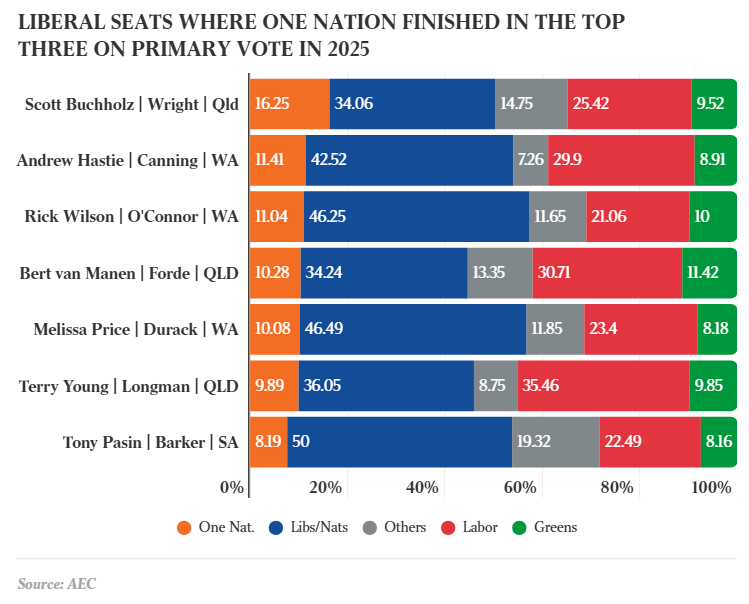
Outside of Taylor, the only names mentioned as potential long-shot alternative leaders are Andrew Hastie and Tim Wilson. And both will be heavily targeted by One Nation and the Climate 200 teals in their respective seats. Wilson has struggled to cut through as opposition Treasury spokesman, while Hastie has been targeted by One Nation supporters of accused war criminal Ben Roberts-Smith.
The recent departure of Andrew Hirst, who became Liberal Party federal director in 2017 and orchestrated Scott Morrison’s “miracle” 2019 election victory, has left a gaping hole in the Liberal organisation. Inquirer has confirmed that Folo, the federal director of the Nationals and a former state director of the Liberal National Party in Queensland, was not the first choice to replace Hirst.
As of this week, Folo still appeared on the Nationals website as their federal director.
Liberals, including some advocating for an outside force to be recruited with deep experience on modern campaigning tools and polling research, point out Folo was working alongside former Nationals leader David Littleproud when the junior partner sought to break up the Coalition and undermine Ley’s leadership. Folo will need to mend relationships on both sides of the fence.
Teflon One Nation
Hanson, her chief adviser James Ashby and high-profile recruit Barnaby Joyce are Australia’s master Teflon political operatives. All three have had plenty thrown at them during their time in politics. Scandal, dysfunction, personal hatred, animosity, revenge and expulsion have been associated with One Nation since the party’s inception in 1997.
Across three decades, the organisation and its colourful and controversial identities (many now deemed surplus to requirements) have been the subject of investigations by media outlets and authorities, while internal spats have ended up in courtrooms.
Hanson and Ashby are so used to scandals and accusations of improper behaviour they have become adept at the art of deflection and obfuscation. Depending on where an issue is floating in the populist wind, they often change their minds on the spot. And most times they get away with it.
Ashby’s work in building digital tools and platforms that allow Hanson to speak directly with supporters and increase the number of eyeballs consuming One Nation content has been phenomenal. Ashby, who is using Trump tactics to freeze out media outlets and shame journalists he believes are unfair to him and Hanson, has recruited a diverse team of experienced digital campaigners who are spreading One Nation messaging far and wide.
A game changer for One Nation has been the wave of major Liberal donors who have shifted their allegiances. Before and after last year’s disastrous Coalition election campaign, prominent names attached to the Liberals have signed up with Hanson.
Hanson and Ashby, who are supported by billionaire mining magnate Gina Rinehart, also have forged global networks with the teams of Farage, Trump and other right-wing leaders.
While valid questions are being asked about One Nation’s ability to recruit credible candidates and wage a large-scale federal election campaign, the flood of new members and the establishment of branches across the country have bolstered the party’s stocks.
Another major flashpoint will be whether Hanson, Ashby, Joyce and other high-profile recruits decide to run for lower house seats or cause maximum disruption in the Senate. Given no one is prepared to call a ceiling or floor on support for One Nation, the key players have no intention of showing their hands at this stage.
But it is difficult to visualise a scenario, as unlikely as it still seems for many political observers, where Hanson allows Joyce or someone else to lead a One Nation opposition or government in the House of Representatives.
Battle stations
Labor campaigners, who will assemble in Adelaide next month for the 50th ALP national conference, retain high confidence that their party machine, backed by the unions and left-wing advocacy groups, is still the most formidable in the country.
At the past two elections, Albanese has benefited strongly from a compulsory preferential voting system that funnels significant support from the Greens and independents to the ALP.
The Greens under Larissa Waters have faded into obscurity after canlosing leader Adam Bandt and rising star Max Chandler-Mather at last year’s federal election. The Climate 200-backed teals also are increasingly irrelevant, with some considering the merits of a moderate conservative party to harvest votes away from the two-main-party system.
The Liberal Party and Nationals machines, which still need to lock in pollsters and ramp up their digital advertising footprints and technologies, are depleted. They have lost experience and voters who won’t return.
Cashed-up conservative activist group Advance, which ran the No campaign against Albanese’s doomed Indigenous voice referendum in 2023 and ruthlessly targeted the Greens at last year’s election, will again be a major player. The group, which has more than 47,000 donors on its books, is already campaigning against rookie Labor MPs in seats across the country. Advance’s access to research, polling and volunteers will be vital in a broader conservative push to oust the Albanese government.
The state elections in Victoria in November this year and in NSW in March next year will provide indicators on how the Coalition parties are travelling, how Labor’s incumbent vote is holding up and what kind of damage One Nation can inflict.
If Albanese decides to push on for a third election campaign in 2028, senior Labor figures will use the spectre of One Nation to rally a spooked Left base and woo middle Australia voters who abandoned Dutton in droves last year.
The Labor leader won’t disregard the negativity being flung at him but will keep talking about making the system work better for Australians to “protect democracy and social cohesion”.
With just under two years until the next federal election, the government has the power of incumbency and resources on its side.
Albanese will not want his legacy remembered for handing power over to a fractious conservative alliance led by One Nation, the Liberals, Nationals and minor parties.

Sir Keir Starmer’s net approval rating had crashed to minus-47 when Anthony Albanese and Mark Carney arrived in London to advise their progressive comrade on how to reboot his flailing leadership and fight Nigel Farage’s Reform UK.