Memo, Mr Albanese: serious money talks – and listens – to Hanson

Originally published by Janet Albrechtsen of The Australian.
10.06.2026
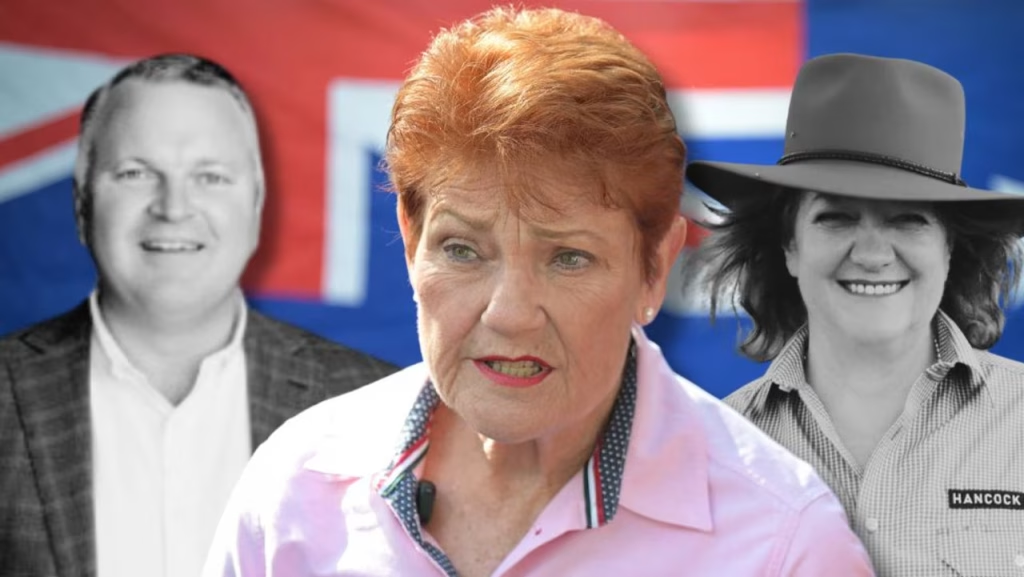
Critics who claim Pauline Hanson is in the pockets of big business are tone deaf. And they can’t count either.
Voters would once participate in democracy by joining one of the big political movements of the 20th century. More than a hip pocket-fuelled tick of the ballot paper, membership likely signalled a belief that the party they joined is not just good for them, but good for the country.
For years now, membership of the Australian Labor Party and the Liberal Party has tanked. By contrast, One Nation’s membership is booming, attracting between 60,000 and 70,000 members, well ahead of the two major parties. Pursing one’s lips offers no insight into the continuing rise of One Nation. Listening to why Hanson is attracting support and money is the starting point to taking Australian voters – and her – seriously.
Could it be that the groundswell of support for Hanson from people across different demographics signals not just grievance, but a love of country too?
Later this week, a group of big business leaders will meet the firebrand One Nation leader at a dinner hosted by Gina Rinehart in Perth. This is not a one-off. On the east coast, too, Hanson’s One Nation party is attracting support – and money – from scions of business who have had enough of the two major parties.
Well-known Sydney stockbroker and businessman Angus Aitken, founder of Aitken Mount Capital Partners, makes no bones about why he switched to One Nation. The former lifelong Liberal supporter says: “Albo is the worst prime minister in my memory and it’s hard to believe anyone could be worse than Malcolm Turnbull as PM, but he is. He has absolutely ruined Australia to the point where flying an Australian flag is in some way bad.”
Aitken and his wife Sarah have donated $1m to One Nation. Given this week’s poll, showing One Nation’s primary vote ahead of the two major parties, Aitken believes a minor change is not enough. He told this column this week: “The country needs a massive reset. It’s cultural and it’s economic.”
A businessman who attended a recent private dinner with Hanson at Aitken’s Sydney home says there was close to $90bn of wealth around the table. They were some of the largest employers in the land. Serious people taking Hanson seriously. What brought them there, says the businessman, was a shared frustration with the constantly changing policies of the two major parties and a growing belief that Hanson is a street-smart realist with a real focus on fixing Australia.
Aitken is known for calling a spade a “f..king” shovel. His grievances with the state of Australian politics are likely shared by millions of other Australians. “The bureaucrats are setting the agenda, and most of them have never worked in the real world,” he says. “When all of those pro-Palestine rallies were happening you could feel people going, ‘what the **##!! has Australia turned into?’. Then you have the Bondi terror attack, and letting in ISIS brides, the shocking treatment of veterans – and you add a budget that will hurt every hardworking Australian.”
The businessman says Albanese has changed the Australian spirit of self-sufficiency to a narrative of welfare and lack of productivity. “If you are a self-starter running a small business, you’re penalised. That is a massive problem where hardworking people see themselves subsidising people who never want to work hard,” he says.

Aitken says the most common question he is asked is whether the party will cannibalise the conservative vote. He predicts a huge swing to One Nation in traditional Labor seats, “from people who just want to work hard, a tradie, a miner or whatever, people who want to get ahead from their own steam, without relying on government handouts”.
“Labor is not the party their mum and dad voted for,” Aitken says. “This is the party of green inner-city woke losers who love wind farms, just not in their backyards.” Aitken is happy to be quoted but other businessmen, who would prefer to remain nameless for fear of retribution, are equally scathing. They come back to the budget as a sign of Labor’s cluelessness and arrogance. They say a big parliamentary majority has infected Albo and the ALP with hubris, which could well cause them to lose government.
But they agree that the conservative side of politics needs to work together, and recognise that the political enemies are Labor, the Greens and the teals. Not One Nation. In the same vein, many readers of this column have expressed what one reader, David, wrote on the weekend: “I’m no fan of Hanson and ON. But I will support them if it makes the Liberal Party liberal again.”
Notwithstanding the shift to One Nation, two big question marks hang over the party’s ability to turn today’s impressive popular momentum into power: the quality of its people, and the quality of its policies.
On one view, battlers such as Hanson and bombasts such as Barnaby Joyce are quintessential Australian characters. And attractive to voters, it would seem. But the turnover in Hanson’s party over the years prompts questions about how cohesive and dedicated her team is, and will be in the future. Hanson’s big personality may explain some of that instability. But the party’s poor infrastructure and less professional style don’t help either.
The nagging question is whether One Nation can attract, and keep, first-rate people. Being a Rhodes Scholar is definitely a mixed blessing – indeed in some cases it can be a clear contraindication of political skill, and the last qualification Hanson would want in her people. While One Nation probably doesn’t need to worry about Rhodes Scholars joining her party, and may not want them to, the question remains: Can it attract serious candidates?
Questions linger too over the quality of One Nation policies. What it is against is tolerably obvious, but what is its core underpinning philosophy? And translating that into day-to-day policies requires a level of economic, legal and policy skill that One Nation may not yet possess. If the heat of an election exposes economic black holes or policy absurdities, the wheels just may come off mid-campaign.
Hanson’s attraction to some of Australia’s leading business leaders signals that One Nation may be listening to people who understand the economy. The question is whether the media and political elites are listening to why Australia’s most enduring political leader has reportedly attracted 60,000 members to the party and is out-polling both major parties.
