Building classrooms for healing

Originally published by Ella Loneragan of Business News
20.04.2026
Parkerville Children and Youth Care is advancing one of the most ambitious projects in its 120-year history.
With plans for a $50 million specialist secondary school designed for young people living with complex trauma, the charity’s annual gala this year provided added incentive for generosity among attendees.
Parkerville Gala 2026 represented the 10th year of support from Hancock Prospecting, Hancock Iron Ore and Australia’s richest woman, Gina Rinehart, whose private donations to the charity go back several years.
About $400,000 was raised from the 200-plus people in attendance for construction of Parkerville Grove School.
Parkerville CYC has now passed the halfway mark in the funding of the $20 million renovation, which involves the upgrades of 13 historic buildings (the most recent of which was built in the 1950s).
It will create an educational space for students who find mainstream schooling environments are not supportive of their emotional, social, and psychological needs.
A further $30 million is a perpetuity fund for the school, where interest will pay for additional support to reduce barriers young people can face in accessing education.
“Given the right conditions and given the right ways of education and given the right world, that healing can happen,” Parkerville CYC chief executive Kim Brooklyn said.
“They could just be anyone, and they could be the most amazing leaders in our community.”
For Ms Brooklyn, this is not just a significant social project, but a long-term economic investment.
“We saw young people failing in the system or the system failing them,” Ms Brooklyn said.
“They were ending up with really bad reputations and failing school or checking out of school and not reaching their full potential.
“We thought, ‘We’re either part of the problem or part of the solution’.”
The organisation will progressively open the specialist school from later this year, beginning with years seven to 10.
As Parkerville secures the capital to renovate the rest of the campus, year 11 will follow in 2027 and year 12 in 2028.
Complex needs
That a need exists is clear from Parkerville’s own data.
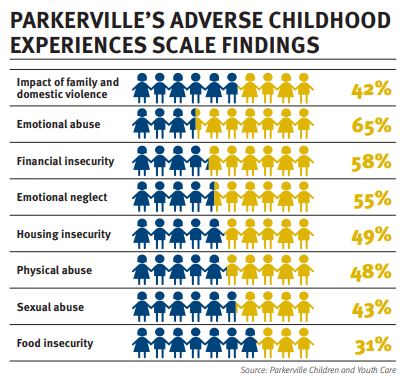
Through its Adverse Childhood Experiences Scale assessments, the charity has analysed 1,056 children and young people.
Of those, 445, or 42 per cent, have experienced the impact of family and domestic violence.
But the data reveals compounding disadvantage.
Among the same cohort, 65 per cent are experiencing emotional abuse, 58 per cent are living with financial insecurity, 55 per cent with emotional neglect and 49 per cent with housing insecurity.
Forty-eight per cent have experienced physical abuse, 43 per cent sexual abuse and 31 per cent food insecurity.
“We know that there are barriers for these young people and we know that, left untreated, complex trauma can result in long-term harm, shortened lifespans, more access to mental health services, higher rates of connection with the justice system and child protection,” Ms Brooklyn said.
“So it’s a good investment in terms of the economic rationalist argument. But just on the pure moral basis, it’s the best investment in these kids because they’ve just got so much opportunity and potential.”
“We really believe that $1 spent in prevention is far more value to the community than $15 spent in crisis”
– Kim Brooklyn
These are among the factors behind the charity’s launch of Parkerville CYC Therapeutic Education Services (PTES) in 2025: an entity to lead trauma-informed education initiatives with its Curriculum and Reengagement in Education (CARE) school model.
“We’ve been thinking about the school since 2021 and really thinking, how can we do this,” Ms Brooklyn said.
“The fact that we’ve got 240 experts in trauma already working for us is the reason we’re doing it.”
Parkerville Grove School will be the first school operated by PTES, but the organisation hopes it’s not the last.
The board, alongside that of Parkerville CYC, is chaired by Colin Pettit, who spent seven years as commissioner for Children and Young People WA.
Liz Criddle also sits on both boards, while Anne Ford, Eirlys Ingram and Ivan McLean make up the rest of the PTES board.
The executive team is formed by Ms Brooklyn as chief executive, company secretary Lynton Bennett and Parkerville Grove School’s foundation principal, Alice Alibrandi.
In December last year, PTES received a $3 million grant from Lotterywest to go towards building its therapeutic services.
Recruitment is under way for specialist teachers, youth workers, administration staff and a finance manager.
Building on experience
Parkerville CYC already operates at scale.
With 240 experts in trauma, the organisation supported 12,700 children, young people and family members last year across metropolitan and regional WA.
“We hit well above our size for the number of people we see … and we don’t turn anyone away,” Ms Brooklyn said.
“If we can’t help them, we certainly try and find somebody who can.”
The George Jones Child, Youth and Family Centre in Armadale is one of three integrated centres in WA operated by Parkerville. It responds to one-third of child sexual abuse reports in the state, according to Parkerville CYC.
Support spans child advocacy, integrated family, early intervention, youth homelessness, out-of-home and foster care, education and employment training, therapeutic and residential care services.
“Everything that we do is either in service to reducing risks [of children going into care] or, if they are at risk, helping them to be less at risk,” Ms Brooklyn said.
“Or if they’re already in care, to try and find really good outcomes for them.
“We really believe that $1 spent in prevention is far more value to the community than $15 spent in crisis.”