Gina Rinehart-backed Lynas Rare Earths posts record quarter

Originally published by Mark Wembridge of The Australian Financial Review
21.04.2026
Lynas Rare Earths’ decision to accelerate production and invest in green power is paying off, after the miner doubled its quarterly revenue and said the adoption of renewable energy had cut diesel use by almost 900,000 litres.
The ASX-listed miner has been among the biggest beneficiaries of a United States-led campaign to secure supplies of rare earths outside of China, which has used its stranglehold over the sector as geopolitical leverage.
Lynas, one of the world’s biggest producers of rare earths outside of China, posted sales in the first three months of 2026 of $265 million, up from $123 million a year ago. Production of its rare earths rose 69 per cent to 3233 tonnes.
The Australian miner was drawn into the spotlight last year when the Pentagon signed a landmark deal with US rare earths provider MP Materials. The agreement included a minimum price for neodymium-praseodymium (NdPr) – elements used in military weapons, electric vehicles and wind turbines.
The $US110 per kilogram floor was roughly double the NdPr price at the time, and the agreement prompted copycat deals with the likes of Lynas that have underpinned new production and exploration.
“Over the past 12 months, three major NdPr offtake deals highlighted accelerating Western efforts to secure non-China rare earth supply. Notably, NdPr price floors at US$110 a kilogram are becoming standardised in these offtake structures,” analysts at Macquarie said.
The miner produces rare earths from its Mt Weld operations in Western Australia and separates the elements at processing facilities in Kalgoorlie and Malaysia. During the quarter, Lynas secured a decade-long extension to its Malaysian refinery licence.
“In the first quarterly results that I delivered [in 2014], we produced 445 tonnes of NdPr. We delivered 2000 tonnes this quarter. It’s a reminder of the steps we have taken to consolidate our position as the global leader outside China,” said Amanda Lacaze, Lynas’ managing director.
Lacaze, who will depart Lynas at the end of June, warned that turmoil in the Middle East would increase some costs, but noted that its use of renewable energy at Mount Weld saved 870,000 litres of diesel in the quarter.
“We were expecting renewables to deliver about 70 per cent of our power requirements [in the quarter], and the average renewable content was 95.7 per cent,” Lacaze said.
Lynas reported an average selling price across all its rare earths of $84.60 a kilogram for the quarter, some 70 per cent higher than the same period last year.
Lacaze, a critic of rare earths pricing, said the miner’s direct sales to customers helped it sidestep the “dysfunctional” spot market. Last month, Lynas signed a long-term supply deal with its Japanese trading partner, Japan Australia Rare Earths, that included a $US110 floor price.
The White House last October signed a $4.6 billion critical minerals agreement with Australia to accelerate production and fast-track potential projects.
The US is also creating a $US12 billion ($17 billion) critical minerals stockpile and a trading block to co-ordinate moves against China’s dominance. Australia is establishing its own critical minerals strategic reserve worth $1.2 billion.
“Everyone has accepted that this market has been dysfunctional for some time, and I think that government agreements have helped to address that,” Lacaze said.
“If we have consistent application across those various agreements, no government should ever actually have to write a cheque because the price naturally will move to that level.”
Lynas is backed by billionaire mining magnate Gina Rinehart, whose company, Hancock Prospecting, is the second-biggest shareholder with a 7.6 per cent stake.
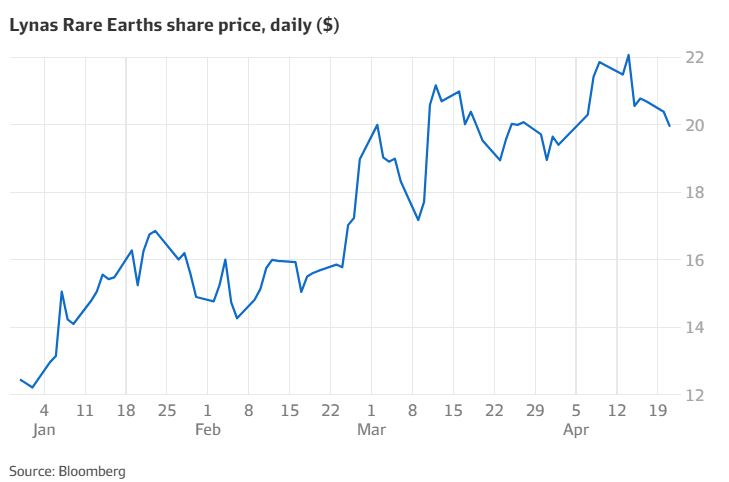
Shares in Lynas, which have more than doubled over the past year, were down 3.2 per cent at $19.74 on Tuesday, giving it a market value of almost $20 billion.
